





Walk-Behind vs. Ride-On Scrubber Dryers – What’s the Difference?
At a Glance
Choosing between walk-behind and ride-on scrubber dryers directly affects cleaning efficiency, labour use, and workplace safety. Walk-behind machines suit smaller, complex spaces requiring precision, while ride-on models are designed for large, open areas where speed and continuous operation are essential. The right choice depends on layout, workload, and operational demands.
Get in touch to discuss your requirements or schedule an appointment.
Choosing The Right Scrubber Dryer Impacts Safety and Overall Cleaning Efficiency
Keeping large commercial floors clean is not just about appearance. It directly affects safety, compliance, productivity and operational efficiency. According to UK facilities management reports, slip-related incidents account for a significant portion of workplace injuries each year, often linked to poor floor maintenance. Add to that rising labour costs and tighter cleaning schedules, and suddenly the choice of cleaning equipment becomes a business decision, not a routine purchase.
This is why asking questions like “How does a scrubber dryer work?” and “What does a walk-behind floor scrubber do?” and, most importantly, comparing walk-behinds vs ride-on scrubber dryers is becoming crucial.
The wrong machine can slow down your team, whereas the right one instantly reduces cleaning time, cuts water and chemical use, saves electricity, and keeps your site compliant.
The focus should always be on choosing a cleaning machine that matches how your facility actually operates. Whether you manage a warehouse, council site, retail unit or a manufacturing floor, knowing the machine variants is more significant than most people expect. Let’s explore this in more detail.
What is a Walk Behind Scrubber Dryer
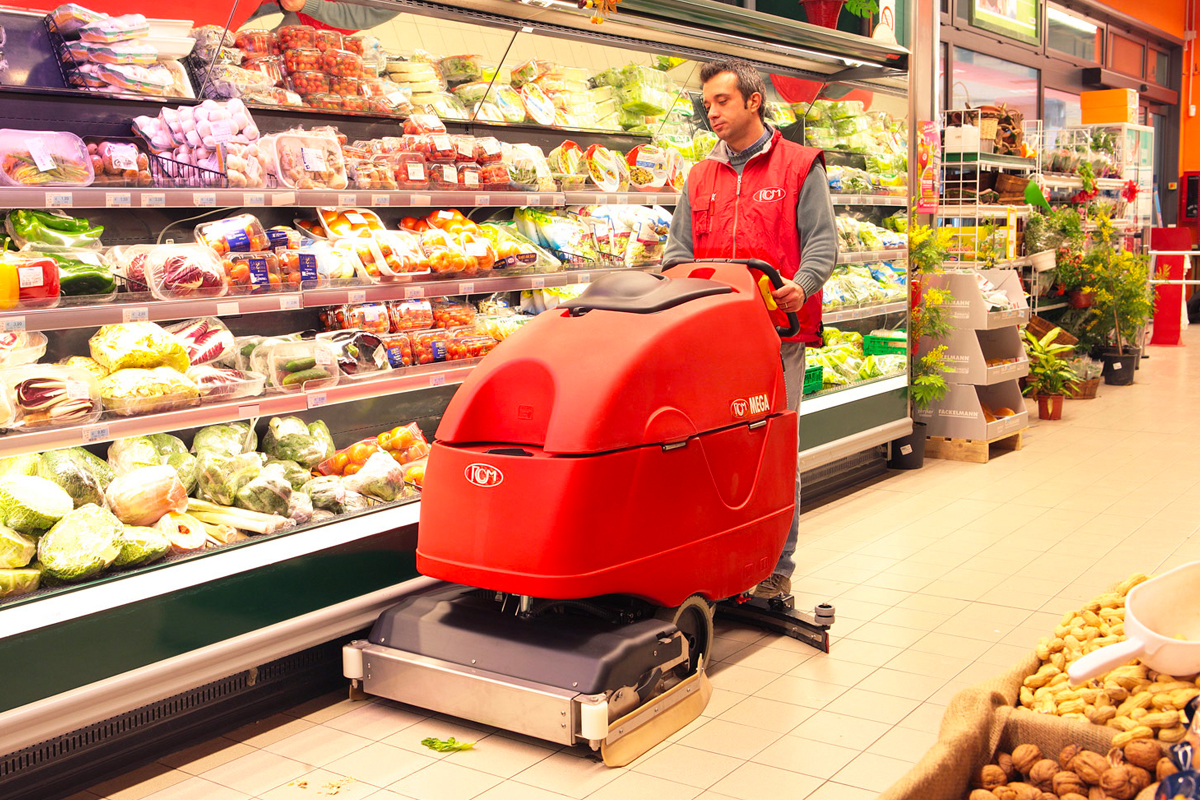
A walk-behind scrubber dryer is exactly what it sounds like: an operator walks behind the machine as it scrubs and dries the floor in a single pass. These machines are commonly used in smaller or more complex spaces where manoeuvrability takes precedence over speed.
How does a scrubber dryer work? It applies cleaning solutions to the floor, scrubs using rotating brushes and then vacuums up the dirty water, leaving the surface dry and safe to walk on almost immediately.
In simple terms, it cleans, lifts dirt, and dries the surface in a single controlled motion, with the operator guiding it through tighter areas. This is a preferred piece of equipment among schools, healthcare settings, retail units with narrow aisles, smaller warehouses and even segmented spaces. They are compact walk-behind models designed for precision cleaning without sacrificing performance.
What is a Ride-On Scrubber Dryer
Now that you know what a walk-behind floor scrubber does, apply the same cleaning process and scale it up with a ride-on seat on the equipment.
A ride-on scrubber dryer allows the operator to sit on the machine and drive it. The cleaning mechanism stays the same, but the machine becomes faster, wider and more capable of covering much larger areas without interruption.
If you revisit how a scrubber dryer works, the distinction here is not in the methods but in capacity. Larger solution tanks mean fewer stops and wider brush decks mean more floor covered in a single pass. Likewise, stronger vacuum systems maintain consistent drying performance even at higher speeds.
These machines tend to appear in environments where walking the floor is simply not practical. Large warehouses, logistics hubs, manufacturing plants, and public-sector buildings all fall into this category.
A walk-behind machine follows the layout of a space, whereas a ride-on machine is better suited to spaces designed for movement along straight, open lines.
Walk Behind vs Ride-On Scrubber Dryer – Key Difference
The difference between a walk-behind and ride-on scrubber dryer becomes clearer when you look at how they behave during a typical cleaning shift.
| Feature | Walk Behind Scrubber Dryer | Ride On Scrubber Dryer |
| Cleaning pace | Set by walking speed | Set by machine speed |
| Coverage | Smaller sections at a time | Larger areas in fewer passes |
| Navigation | Easier in tight layouts | Better in an open layout |
| Tank size | Requires more frequent refilling | Longer run time between stops |
| Operator effort | Physically involved | Less strain over longer shifts |
Similarly, know that when comparing a walk-behind vs a ride-on floor scrubber, the distinction is not just technical. It shows up in how long tasks take, how often machines stop, and, eventually, how operators feel at the end of every shift.
When a Walk-Behind Scrubber Dryer Makes More Sense
There is a tendency to assume that larger machines solve more problems. However, that is not always the case, as a walk-behind scrubber dryer tends to work better when:
- The space includes corners, shelves, obstacles and narrow walkways
- Cleaning happens in shorter sessions and not in long continuous runs
- Having access to areas takes priority compared to speed
For facilities teams, these machines provide better coverage, particularly around edges, and make difficult layouts easier to manage. Another benefit is that they are easier to store and transport between locations. Training new operators is also simple and requires little time. These characteristics are important in settings where cleaning is part of a larger routine, as these areas require ongoing flexibility.
When a Ride-On Scrubber Dryer Is the Better Choice
Now consider a large warehouse with multiple floors that needs to be cleaned daily. In situations like these, when time is limited and the area is extensive, a ride-on scrubber dryer is a better fit. Facilities with wide floor space, where operators regularly cover longer distances, choose ride-on scrubber dryers.
After analysing the differences between walk-behind and ride-on scrubber dryers, managers opt for the ride-on version primarily to achieve speed and consistency. Operators also tend to experience less fatigue during long shifts, which noticeably impacts productivity and attention to detail. For councils and industrial sites, this aligns with how cleaning schedules are structured.
Which Scrubber Dryer is Right for Your Facility
The comparisons between walk-behind and ride-on scrubber dryers have become less abstract and more practical. Nonetheless, if you are still unsure, then answer a simple question, “Are your floors broken up by shelving, equipment or foot traffic that changes throughout the day? Or are they wide open and predictable?”
If your facility has tighter layouts or varied zones, a walk-behind machine usually settles into the environment more comfortably. It allows operators to adjust as they move, taking corners and obstacles in stride without overthinking the route. On the other hand, if your space opens up into long, uninterrupted stretches, a ride-on machine feels less like an upgrade and more like a necessity. It keeps movement steady and reduces the time spent going over the same ground.
There is also the human side of things when deciding which scrubber dryer to buy. Things like shift changes, weather conditions, additional operations, and time pressure are usually underestimated. The right option tends to make provisions for these areas as well, without creating friction.
Speak to Euromec About the Right Scrubber Dryer for Your Business
Cleaning equipment suppliers such as Euromec can help assess how these machines perform in your setting. Speak to our experts and book a live demo, so that you can see these machines in action.
We help you choose beyond specifications alone and assist you in understanding the real-world performance of this cleaning equipment, whether it’s a walk-behind or ride-on scrubber dryer.
Euromec supplies a wide range of industrial cleaning equipment, including scrubber dryers and sweepers, along with trusted brands such as RCM, Iseki, Honda and Stiga. We also back it up with after-sales service, support parts availability, and expert advice on machines.
Explore the full range of scrubber dryers to find a machine that fits your operational needs or connect with us for more information.

Nikki
Director
Nicola has worked in the cleaning machine industry for 18 years across both Sales and Service. Nicola has an comprehensive knowledge of a range of cleaning machine makes and models, and has been instrumental in the sale and servicing of machines across a vast range of applications.